El Paso Temporary Flight Restrictions Explained for Drone Pilots
Understanding Temporary Flight Restrictions in El Paso

Flying in or near El Paso without checking current airspace conditions can create unnecessary risk for both your drone and your remote pilot certificate. A Temporary Flight Restriction, often called a TFR, can change where and how you are allowed to fly, especially near El Paso International Airport, Fort Bliss, and the surrounding border region.
This guide explains what a Temporary Flight Restriction means for drone pilots in El Paso and walks you through how to verify airspace properly before every launch.
What Is a Temporary Flight Restriction (TFR)
A Temporary Flight Restriction, commonly referred to as a TFR, is a short term change to the airspace rules in a specific area. When a TFR is active, normal flight permissions may no longer apply.
These restrictions can be issued with little notice and may affect both manned aircraft and drones. If you are planning to fly in El Paso, understanding how a TFR works helps you avoid violations and adjust your flight plan before takeoff.

How the Federal Aviation Administration Issues a Temporary Flight Restriction Through a Notice to Air Missions (NOTAM)
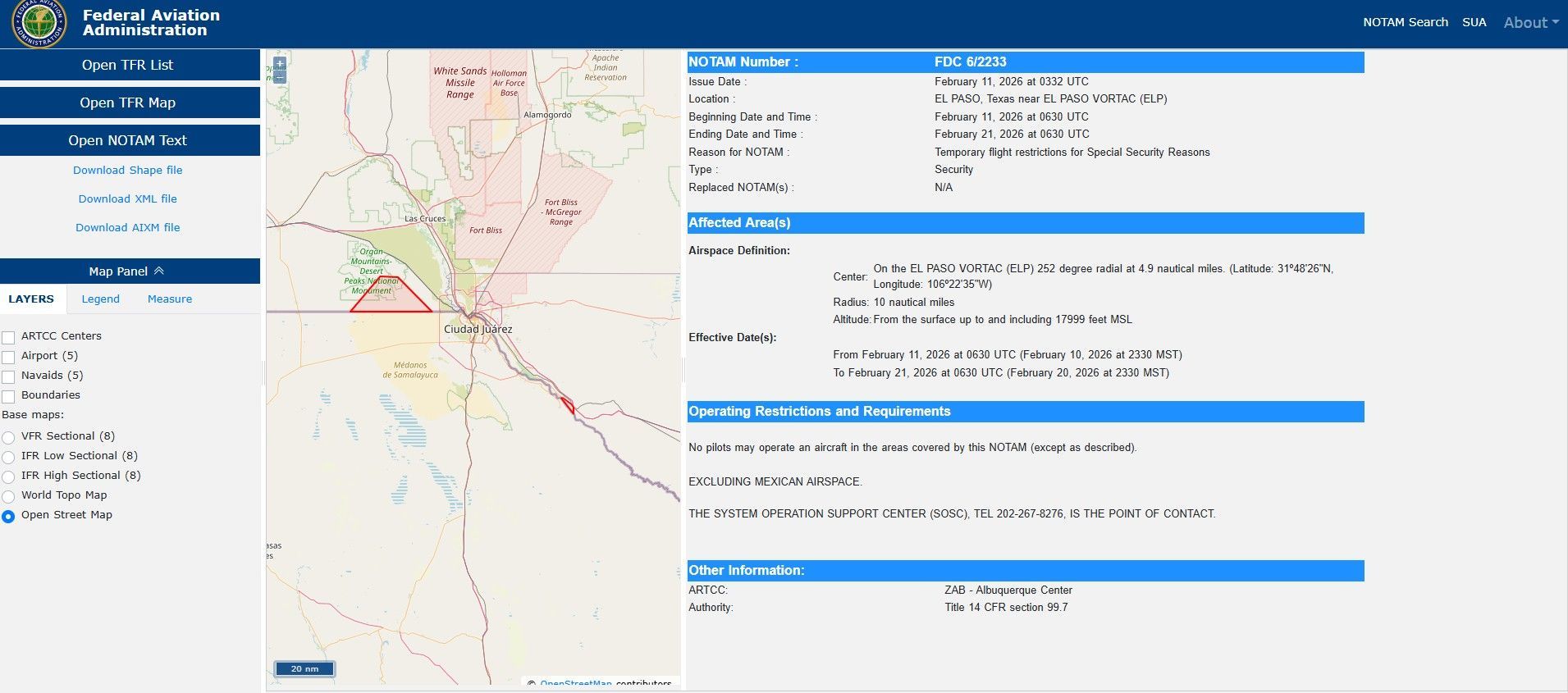
The Federal Aviation Administration, or FAA, announces Temporary Flight Restrictions through a system called the Notice to Air Missions, commonly referred to as a NOTAM.
A NOTAM is simply an official alert that tells pilots when something has changed in the airspace. When a TFR is issued, it appears in the NOTAM system and includes details such as the location, altitude limits, start time, and end time.
Before flying, pilots are expected to review active NOTAMs for their area. Skipping that step can lead to violations, even if you were unaware the restriction was in place. That is why checking NOTAMs is part of responsible preflight planning.
How a Temporary Flight Restriction Differs From Controlled Airspace
Controlled airspace is permanent. It has defined boundaries and established rules that generally stay the same from day to day.
A Temporary Flight Restriction is different. It is not permanent and can appear within any type of airspace for a specific purpose and limited period of time. Once active, it temporarily changes the normal rules for that area.
For drone pilots, this distinction matters. Just because you normally have permission to fly in an area does not mean you can fly there while a TFR is active.
Why a Temporary Flight Restriction Overrides Normal Flight Operations
Temporary Flight Restrictions take priority over standard airspace permissions. They are issued for reasons such as national security, emergency response, or public safety.
If a TFR is active, it overrides routine operations. Even if you previously received authorization or typically fly legally in that airspace, the TFR changes the rules while it is in effect.
That is why verifying current airspace conditions before every launch is critical. A valid flight plan this morning may not be valid this afternoon if a new restriction is issued.

Why Temporary Flight Restrictions Occur in El Paso
If you fly in El Paso, you are operating in a unique airspace environment. The city sits along the United States–Mexico border and near several sensitive aviation areas, including a busy commercial airport and military installations. Because of that combination, Temporary Flight Restrictions can appear from time to time.
That does not mean airspace is constantly restricted. It means conditions can change, and professional drone operators plan accordingly.
Here are the most common reasons a Temporary Flight Restriction may be issued in this region.
Border Region Operational Considerations
El Paso’s location along the international boundary creates additional coordination in the airspace. Temporary adjustments may be made to support border operations or manage aircraft activity safely near sensitive areas.
When a Temporary Flight Restriction is issued for these reasons, it helps ensure safe and organized use of the airspace.
For you as a drone pilot, the takeaway is simple: check before you launch. Even if you have flown that location before, the rules can change temporarily.
National Security and Defense Activity
El Paso is also home to Fort Bliss and other defense-related activity. Military exercises or coordinated operations may occasionally require temporary changes to the surrounding airspace.
If a Temporary Flight Restriction is active for this reason, it applies to all aircraft, including drones.
Awareness is what protects you. A quick airspace check can prevent violations and keep your operations lawful.
Emergency Response and Special Events
Emergency responses and special events can also lead to TFRs in El Paso. Large gatherings or emergency situations might require restricted airspace to ensure public safety. These TFRs help manage air traffic and protect both people and property. For drone operators, understanding the potential for these restrictions allows for better planning and responsiveness to changing conditions.
Do Temporary Flight Restrictions Apply to Drone Pilots Under Part 107
Short answer: yes.
If you are flying a drone in El Paso, a Temporary Flight Restriction applies to you. It does not matter if you are flying commercially under Part 107 or recreationally for fun. When a TFR is active, it temporarily changes the rules for everyone in that airspace.
Where confusion usually happens is in how those rules interact with normal permissions.
Commercial Operators Holding a Part 107 Remote Pilot Certificate
If you hold a Part 107 Remote Pilot Certificate, reviewing airspace before every flight is already part of your responsibility. That includes checking for active Temporary Flight Restrictions.
If a TFR covers your intended flight area, you cannot operate there unless the restriction specifically allows unmanned aircraft operations. Even if you have flown that exact location many times before, the TFR overrides your usual permissions while it is active.
Think of it this way: your certification allows you to operate legally, but it does not exempt you from temporary airspace changes.
Recreational Drone Pilots Flying Under Exception for Recreational Flyers
Recreational pilots sometimes assume TFRs are mainly a commercial issue. They are not.
Temporary Flight Restrictions apply to all aircraft operating in that airspace, including drones flown recreationally. The airspace does not distinguish between hobby and commercial use once a restriction is in place.
If a TFR is active, the safest decision is to stay clear of that area until it expires.
Why Low Altitude Authorization and Notification Capability (LAANC) Authorization Does Not Override a Temporary Flight Restriction
This is one of the most common misunderstandings.
Low Altitude Authorization and Notification Capability, or LAANC, provides authorization to operate in controlled airspace under normal conditions. It does not override a Temporary Flight Restriction.
If you receive LAANC approval in the morning and a TFR is issued later that day covering the same location, the TFR takes priority. Your earlier authorization does not cancel the restriction.
That is why professional pilots check both LAANC status and active NOTAMs before every launch. One does not replace the other.
How to Check for Active Temporary Flight Restrictions Before Flying in El Paso
Checking for a Temporary Flight Restriction is not complicated, but it must be deliberate. In El Paso, airspace can change because of border activity, military operations, airport traffic, or emergency response. That means you
cannot rely on memory or past flights.
So here is the simple approach I teach students.
Reviewing the Federal Aviation Administration Notice to Air Missions (NOTAM) System
The Notice to Air Missions system is where Temporary Flight Restrictions are officially published.
If a TFR is active, the NOTAM will list the exact area, altitude limits, and the time window it applies. This is the official source of record.
Apps may summarize restrictions, but the NOTAM system tells you exactly what changed and when it expires. Reviewing it takes only a few minutes and removes guesswork.
Using B4UFLY and Low Altitude Authorization and Notification Capability (LAANC) Tools
After checking NOTAMs, use B4UFLY for a visual overview of the airspace. It helps you see restrictions and controlled airspace boundaries on a map.
Low Altitude Authorization and Notification Capability, or LAANC, allows you to request authorization in controlled airspace near El Paso International Airport under normal conditions.
Remember: LAANC does not replace checking for a Temporary Flight Restriction. It serves a different purpose. Both steps are part of responsible planning.
Checking Airspace Near El Paso International Airport
El Paso International Airport sits inside Class C airspace. That simply means drone flights in much of the surrounding area require authorization before you take off.
Under normal conditions, you would request that authorization through LAANC. That process coordinates your flight with Air Traffic Control so manned aircraft and drones stay separated safely.
Now here is where it gets important.
If a Temporary Flight Restriction overlaps that Class C airspace, the rules can change quickly. Even if you normally receive LAANC approval in that area, a TFR can restrict or pause operations while it is active.
So before flying near the airport, ask yourself three simple questions:
- Am I inside Class C airspace?
- Do I need LAANC authorization?
- Is there an active Temporary Flight Restriction over this area?
If you cannot confidently answer all three, do not launch yet.
Airspace near airports is already busy. A quick verification keeps your operation professional and predictable.
Why You Should Recheck Airspace the Day of Flight
Temporary Flight Restrictions can be issued or lifted with little notice. That is just how the system works.
You might check airspace on Monday for a Thursday shoot and see nothing unusual. But between those days, a wildfire response, security operation, or coordinated activity could trigger a new restriction. If you only rely on your earlier check, you are operating on outdated information.
Airspace is dynamic. Especially in El Paso.
That is why professional pilots recheck airspace the morning of the flight and again just before launch. It takes a few minutes, but it confirms that nothing changed overnight or even within the last hour.
Think of it like a weather check. You would not rely on a forecast from three days ago. Airspace is no different.
That simple habit protects your certificate, your reputation, and the trust your clients place in you.
What Happens If You Violate a Temporary Flight Restriction
Violating a Temporary Flight Restriction is not something most pilots plan to do. In many cases, it happens because someone did not recheck airspace or misunderstood how a restriction applied.
But once you launch, the responsibility is yours.
Understanding what can happen is not about creating fear. It is about understanding risk so you can manage it properly.
Civil Penalties and Fines
Flying inside a restricted area can result in civil penalties issued by the Federal Aviation Administration. The exact amount depends on the circumstances, but violations can carry financial consequences.
Beyond the financial side, there is another impact that matters more: documentation.
An enforcement action creates a record. That record can follow you when applying for contracts, working with government agencies, or building professional credibility.
In most cases, the root cause is simple. The pilot did not verify current airspace conditions before takeoff.
That is preventable.
Suspension or Revocation of a Part 107 Remote Pilot Certificate
If you hold a Part 107 certificate, enforcement action can go further.
In more serious cases, the Federal Aviation Administration can suspend or revoke your certificate. That means you would not be able to operate commercially during that time.
For someone building a business or just getting started, that interruption can be significant.
The good news is this: TFR violations are rarely complicated. They usually come down to one missed step in preflight planning.
A consistent airspace check prevents almost all of it.
Recent El Paso Airspace Activity and Lessons for Drone Operators
A recent Temporary Flight Restriction in El Paso caught many drone pilots off guard. The restriction covered a defined radius around El Paso International Airport and temporarily limited certain operations in that area.
For operators who had flights planned nearby, it meant immediate adjustment.
The takeaway was not panic. It was awareness.
Airspace can change quickly, even in locations where you have flown before.
Summary of the Recently Announced Temporary Flight Restriction
The recent TFR was issued with a specific start and end time and applied within a defined boundary near the airport.
That is how most Temporary Flight Restrictions work. They are precise. They are time limited. And they override normal operations while active.
For drone pilots, the impact is simple. If your planned launch point falls inside that boundary during the active window, you cannot operate there unless the restriction specifically allows it.
The restriction was later lifted. But the lesson remained.

How Quickly Airspace Conditions Can Change
You may check airspace in the evening and see nothing unusual. By the next morning, a new NOTAM can be issued that changes the rules for that exact location.
That is not unusual in a city like El Paso.
Between the commercial airport, military presence, and border activity, airspace adjustments are part of the operational landscape.
This is why relying on memory or past experience is risky.
Airspace is dynamic. Verification must be current.
Practical Takeaways for Local Drone Pilots
If you fly in El Paso regularly, there are a few habits that make a difference:
- Do not assume yesterday’s clearance applies today.
- Check NOTAMs and airspace tools the day of flight.
- Build a buffer into your schedule in case conditions change.
None of this is complicated. It is simply part of operating professionally in a regulated environment.
The recent Temporary Flight Restriction was a reminder of that.
Professional Drone Operations in Border Airspace
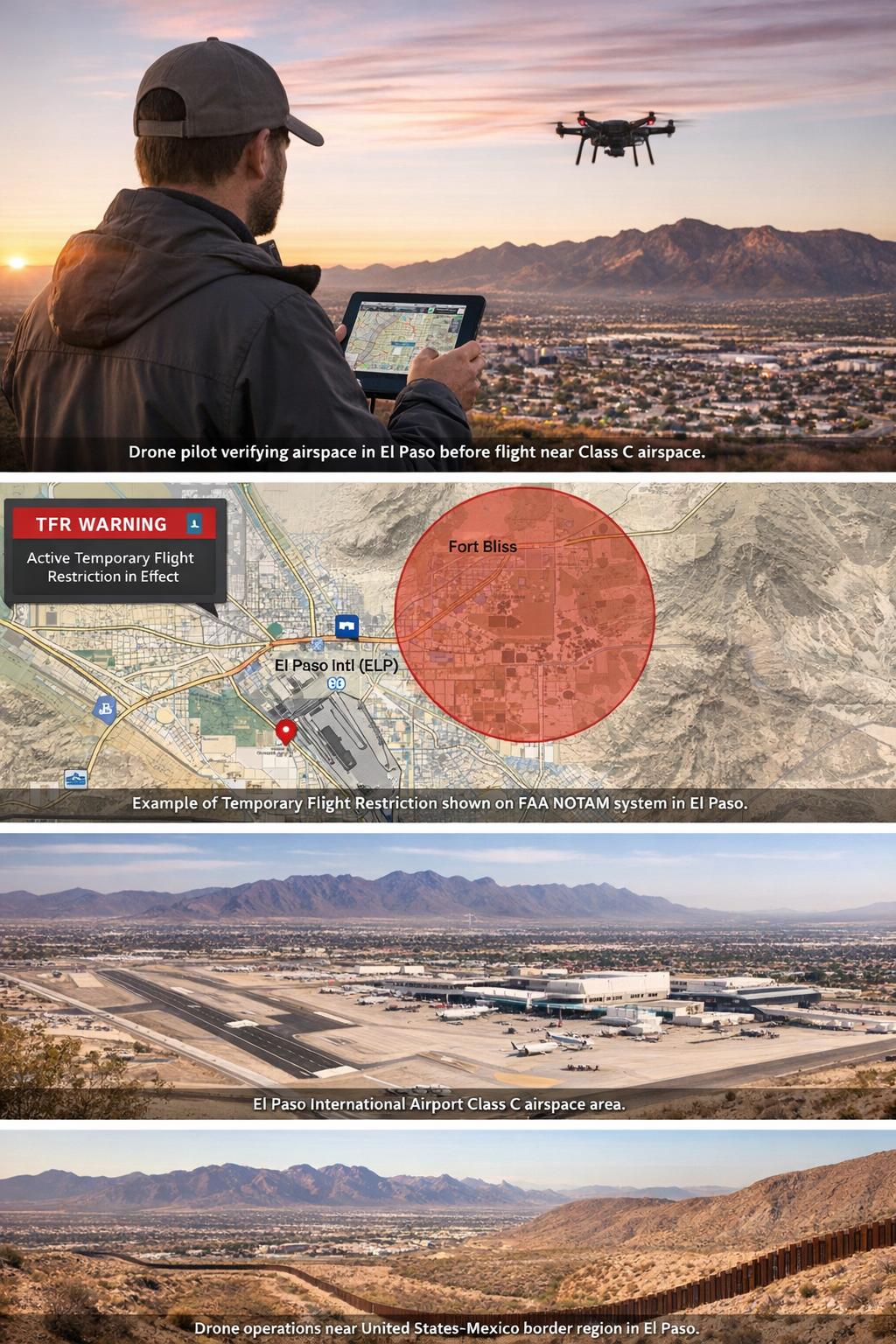
Operating in El Paso is not the same as flying in an open rural field. Here, you are flying near Class C airspace around El Paso International Airport, near Fort Bliss, and along the United States–Mexico border.
Each of those affects how you plan your flight.
- If you are near the airport, you may need authorization.
- If you are near Fort Bliss, activity in the area can influence surrounding airspace.
- If you are close to the international boundary, coordination and security considerations can come into play.
None of this makes flying impossible. It simply means you need to check your airspace carefully before launch.

Stay Above It: Airspace Awareness Is Part of the Mission
Airspace awareness is not an abstract concept. It shows up in small decisions before you launch. For example, you might arrive near the airport for a commercial shoot after checking airspace a few days earlier. Everything looked clear at that time. Before powering on, you check again and discover a Temporary Flight Restriction active until later in the afternoon. Instead of launching and hoping it does not apply to you, you adjust the schedule and inform your client. That is not overcaution. That is disciplined operation.
Verifying airspace should feel no different than checking weather conditions or confirming battery levels. It is simply part of the routine. Most violations do not happen because someone intended to ignore the rules. They happen because someone assumed conditions had not changed.
If you are new to flying in El Paso, the mix of Class C airspace, military activity, and proximity to the international boundary can seem complex at first. It becomes manageable once you understand what to verify and when to verify it. Confidence does not come from memorizing regulations. It comes from knowing you checked the current conditions before you launched.
If you want structured guidance on operating in regulated airspace, our FAA Part 107 training program covers airspace, Temporary Flight Restrictions, and real-world flight planning in El Paso.
Stay informed. Stay compliant. Stay Above It.